I’m seeing a lot of conversation on Reddit, Substack, X, Instagram, TikTok- you name it about the trend of leaving dating apps. Articles on why swiping has created exhaustion, why the deletion rates are increasing, and on top of the already said safety concerns when it comes to online dating and dating apps, Bumble has officially removed its women-first rule. The business models are continually adjusting, as they should, but I believe we are adjusting to a system that will harm more than connect us.
One of the articles I read, by Bettina Arndt, said that the apps have turned an already extended period of dating into a “brutal marketplace of seeking and rejecting.” “Men and women alike emerge from a decade of seeking and rejecting partners battered, bruised and wary. And a growing number simply give up,” said Bettina Arndt. But out of all the articles I’ve read the past week, I saw a gap that I know needs to be addressed.
. . .

Click To View Bettina's Article
. . .
Throughout reading the conversations, articles, and other takes, what I didn’t see was the part that drove me off the apps in the first place: how your profile transcends and leaks into real life. How once you’re visible, the “no” you give by not swiping can still show up in the grocery store, at the bar, or on the sidewalk.
Women are leaving dating apps in large waves, and I’m not surprised. In the beginning, when Tinder first came around, it was fun; it felt new, and we were challenged to meet people we maybe wouldn’t have run into on our day-to-day path, or perhaps even give a hello back to. But throughout the years, we have systematically adjusted to life with dating apps, dating apps being the main reason new relationships begin, or perhaps end by cheating, as accessibility to eligible others is at its highest.
A decade later, dating apps are no longer a novelty but a normal part of our daily lives. Somewhere during that time, the same visibility that made dating apps useful began to make real life a lot less private. The privacy that disappeared was intentional, consciously or not. Like the paranoia around having an Alexa in your home, it felt like convenience at first, then slowly the boundaries are removed between your data, your profile, and the real world walking around you. Where a “no” on the app no longer meant you wouldn’t be found and approached offline.
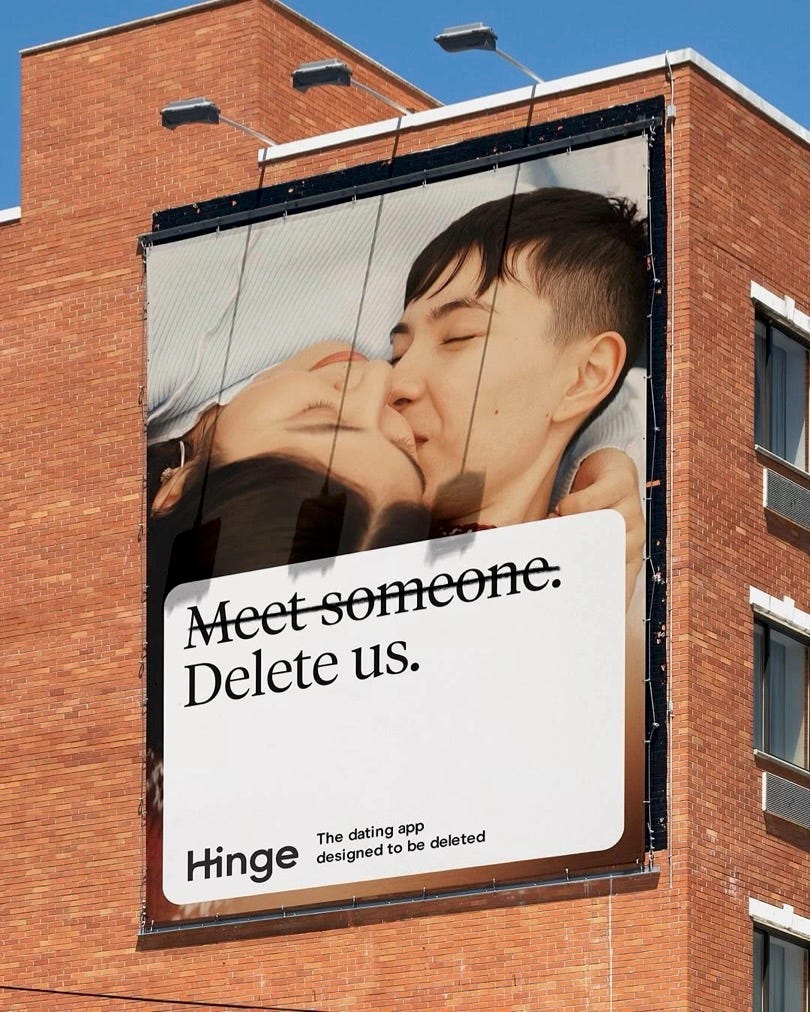
Those around me in relationships who didn’t meet on Hinge, Raya, Bumble, or whatever other app there is now wear their origin story like a badge of honor, doing it IRL vs online. Though the number is quite slim.
Dating apps have created mass visibility to all those around you, or your profile’s chosen location. They’re designed for visibility, which is why often the visibility will expand to real life.
Originally, I left Hinge because of a safety concern. I was being approached while at the grocery store, at the bar with a friend, or just out and about during my day-to-day life, by men I had not swiped right on.
Persistence is rewarded in society right now—persistence in getting the job, finishing the degree, or getting the girl. When approached by said men I didn’t swipe on, I’d proceed with a sassy remark, “Well, I didn’t swipe on you, so bye.” Nine times out of ten, they followed up with questions, with an ask for a date, to give them a chance, and a plea of why we would be a great match despite me finding them utterly repulsive.
This wasn’t limited to low-status men, or men that looked or didn’t look the part. Their attributes had no correlation; the behavior wasn’t confined to simply men who were clearly shooting out of their league, but men of all calibers.
It happened all the time, in small cities, in big cities, and of course small towns where visibility is much higher due to the lower number of participants. Density and anonymity do not protect a woman once her profile has been viewed.
So why are non-swipes treated as an invitation to try in real life? My name is quite unique, Sheridan, so perhaps I am more alone in this phenomenon than I thought, and if not, please chime in, ladies.
I later moved to Raya exclusively, thinking that Hinge was too visible, and perhaps that would be a better alternative. Though it wasn’t much better. Yes, there were fewer people in my area viewing my profile, as the participants in my cities on Raya vs. Hinge were drastically different. I thought that perhaps with the exclusivity and the smaller dating pool would mean fewer random approaches in real life. And that was correct, but when you take into account the population of both of those apps next to each other, the numbers are perhaps the same, if not more consistent on Raya. Maybe it was the exclusivity and the acceptance of being a Raya member at the time that gave certain men a cloak of confidence that we are a match, or that I’d even return the feeling of being somewhat interested. In the end, I believe the higher barriers did not remove the core problem of visibility, only making it more luxurious to note irl and give it a try.
I’m not on any dating apps, nor looking; I’m taken, actually, but I see the pattern continuing. That same visibility leaks into so many areas of our lives, and not just online. The pressure to stay visible and the rewards of doing so are incredibly high, inflated, and consistently regarded as the way to ‘make it’ today. Men are still operating under the value that persistence is key, despite being told no in every shade of black, white, and greys. But the cost of persistence is paid by women, not the company that made the application.
xo,
Sheridan Guerrette
WhatSheridanSaid.com
Wed @ 9/8 Central Chicago